FormKit
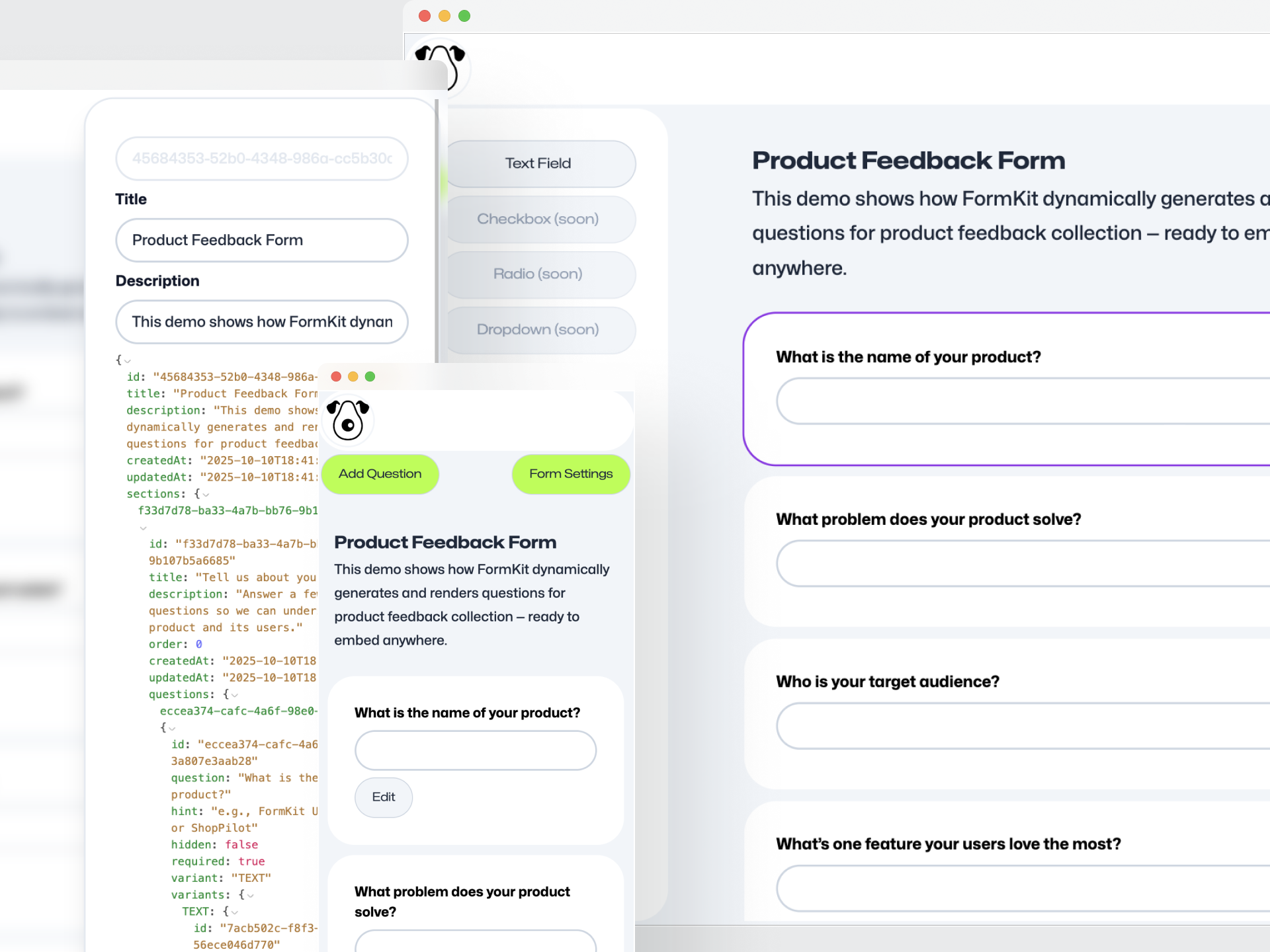
A schema-driven form management system for modern SaaS teams
Design and manage complex intake forms without redeploying your application.
FormKit lets product teams update forms visually while engineers embed once and stay out of the way — with accessibility enforced by default.
What is FormKit?
FormKit is a production-grade form builder and runtime renderer designed for real SaaS products.
Forms are defined as schemas, edited in a visual interface, and rendered inside applications using a single embedded component. Once embedded, forms can evolve without requiring code changes or redeploys.
The goal is simple: reduce friction between product iteration and engineering stability.
Why FormKit Exists
In many SaaS applications, forms become a bottleneck:
Every change requires engineering time
Small updates trigger redeploys
Accessibility is handled inconsistently
Logic is duplicated across apps
These problems compound as products scale.
FormKit was built to solve form management at the system level, not with ad-hoc fixes.
How It Works
Forms are defined using a predictable schema
Product teams design and update forms in a visual builder
Applications embed the form renderer once
Updates propagate instantly without redeploying
This separation keeps iteration fast while preserving engineering control.
Designed for Real-World SaaS
FormKit is not a toy builder. It is designed with production constraints in mind:
Schema-driven rendering for consistency and predictability
Accessibility rules enforced by design, not by convention
Support for complex state, validation, and conditional logic
Multi-tenant and embed-first architecture
Built to integrate into existing React and Vue applications
Every decision favors correctness, clarity, and long-term maintainability.
Design System Integration
FormKit is built to integrate cleanly with existing design systems.
It exposes hooks and extension points that allow teams to map form structure, states, and behaviors directly to their own tokens, components, and styling conventions.
For teams without an existing system, FormKit provides an out-of-the-box integration with SystemHaus — a token-driven design system engine built to power consistent theming across products.
This makes it possible to align forms with the rest of the product UI without custom glue code or one-off overrides.
Learn More
For a detailed breakdown of the architecture, tradeoffs, and implementation decisions behind FormKit, read the full case study.